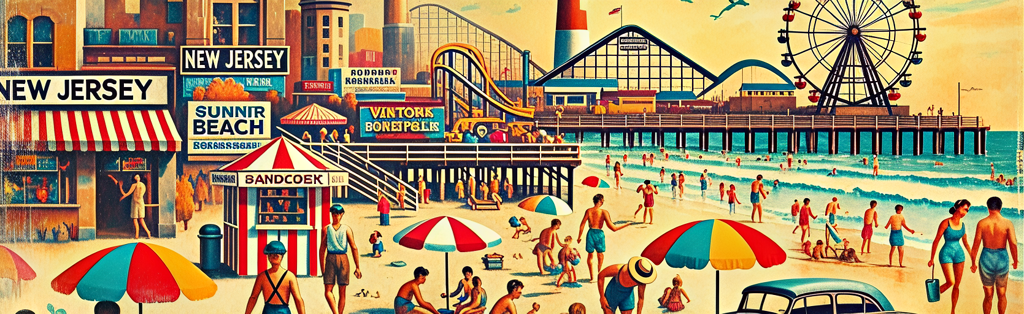
Americana art fits naturally within the subjects of retro art because it has always been about what people actually see around them. Roads, storefronts, schools, diners, small towns, workplaces, coastlines, neighborhoods. Americana is not defined by a single style. It is defined by subject matter — by scenes of American life as it is lived.
Earlier Americana art often showed its subjects directly, as part of the present. Artists painted towns, workers, and landscapes as they existed at the time, without much distance. Mid-century Americana, in particular, reflected its own moment — its routines, optimism, and assumptions — while those scenes were still active parts of daily life. Retro art enters when those same subjects no longer feel current.
Retro art looks at Americana subjects after time has created separation. That separation is what makes them retro. Modern Americana art often focuses on the same subjects as earlier Americana — ordinary places and shared environments — but it approaches them differently. The goal is no longer to describe how these places function, but to reflect how they are remembered. The scenes are familiar, but they feel paused. Less busy. More settled.
This is why Americana subjects work so well within retro art today. They were designed for repetition. People passed through them day after day without noticing. Once those rhythms fade, the places become visible in a new way.
Contemporary Americana art often emphasizes atmosphere over detail. Streets are quieter. Buildings are simplified. Landscapes feel open and still. The image doesn't document a specific moment; it suggests a pattern of living that once existed across many places.
Many of these works are created using modern, collaborative processes, often combining human direction with digital or AI-assisted tools. That doesn't make the subjects less authentic. It reinforces the idea that Americana is not frozen in the past. The subjects remain relevant, even as the methods evolve.
Importantly, much of today's Americana art does not resemble earlier Americana in style. It may not carry the bold narrative tone or illustrative detail of mid-century work. Instead, it leans toward restraint. The subject matter stays familiar, but the presentation is more reflective.
Retro perspective allows Americana subjects to be seen without urgency. A town doesn't need to thrive. A road doesn't need traffic. A building doesn't need people inside it. The scene holds meaning simply because it once played a role in everyday life.
Within the subjects of retro art, Americana stands as a record of lived environments — places shaped by routine, softened by time, and remembered not for what happened there, but for how often people passed through. That quiet familiarity is why Americana remains one of the most enduring subjects in retro art today.
All art and text copyright © 2025 Retro Art World. All rights reserved.